
New Evidence That Meteorite Did Not Wipe Out Dinosaurs


Princeton geoscientist Gerta Keller and a research team have compiled new evidence disproving a popular theory that an asteroid wiped out the dinosaurs about 65 million years ago. Examinations at several new sites have produced biotic evidence - the fossilized traces of plants and animals - indicating that a massive die-off did not occur directly after a proposed asteroid strike but much later. (Photo: Denise Applewhite)
by Staff Writers
Princeton NJ (SPX) May 05, 2009
A Princeton University geoscientist who has stirred controversy with her studies challenging a popular theory that an asteroid wiped out the dinosaurs has compiled powerful new evidence asserting her position.

Gerta Keller, whose studies of rock formations at many sites in the United States, Mexico and India have led her to conclude that volcanoes, not a vast meteorite, were the more likely culprits in the demise of the Earth's giant reptiles, is producing new data supporting her claim.

Keller, a Princeton professor of geosciences, and several co-authors lay out the case in a paper published April 27 in the Journal of the Geological Society of London.

Examinations at several new sites have produced "biotic evidence" - the fossilized traces of plants and animals tied to the period in question - indicating that a massive die-off did not occur directly after the strike but much later.

In addition, Keller and other researchers have found "aftermath" sediments that remained undisturbed and showed signs of active life, with burrows formed by creatures colonizing the ocean floor. This would quash a theory advanced by some that a massive tsunami followed the impact, Keller said.

"Careful documentation of results that are reproducible and verifiable will uncover what really happened," Keller said. "This study takes an important step in that direction."

Much of the new data comes from a trench dug out of low-lying hills in northeastern Mexico at a site called El Penon. A group of Princeton undergraduates accompanying Keller on a field trip to Mexico in 2004 excavated the area and uncovered the new evidence. Keller and her team have been analyzing that evidence for the last several years.

Understanding what caused the dinosaurs to disappear remains a great mystery.
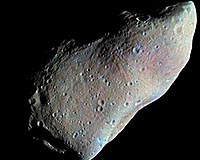
Can We Predict When An Asteroid Will Impact Earth


951 Gaspra is an S-type asteroid (of silicaceous or stony composition, hence the name) that orbits very close to the inner edge of the main asteroid belt. Gaspra was the first asteroid ever to be closely approached, when it was visited by NASA's Galileo spacecraft, which flew by on its way to Jupiter on 29 October 1991. Credit: NASA.
by Staff Writers
Bonn, Germany (SPX) May 19, 2009
Objects with orbits that bring them near to Earth are potential killers. These objects, known as NEOs (Near-Earth Objects), are asteroids (see the astronomy question from week 19: Where is the planet between Mars and Jupiter?) or comets, which we can recognise when they are in the vicinity of the Sun by their characteristic tail.

If these small heavenly bodies cross Earth's orbit while they are orbiting the Sun, it could lead to a collision - a so-called 'impact event'. Can such impacts be predicted?

Dust particles often penetrate the atmosphere and simply cause a harmless light - a shooting star. Less common large bodies leave craters in the Earth's surface or cause tidal waves when they hit the sea. NEOs of around one kilometre or more in diameter can have global consequences, regardless of where they impact.

The extinction of species that took place 65 million years ago, which claimed the dinosaurs amongst its victims, was most likely caused by the impact of a 10 kilometre-wide asteroid. It tore a 180 kilometre-wide crater in the Yukatan peninsula on the Gulf of Mexico.

The most recent larger impact event occurred in 1908, near the Stony Tunguska River, in Siberia. An S-type asteroid (of silicaceous or stony composition, hence the name) asteroid, which was around 30 to 50 metres across, entered the atmosphere at a speed of 15 kilometres per second and released its momentum several kilometres above the ground in an explosion.

It destroyed a region of forest with an area of over 2200 square kilometres - twice the area of Berlin.

However comprehensive forecasts are still not possible

There are probably over one million NEOs that are larger than 30 metres in size; of these, over one hundred thousand are larger than 100 metres and approximately one thousand are at least 1 kilometre in size.

The average period of time between the impacts of two similar-sized NEOs can give us a vague idea of the probability of an impact event occurring: 30 metre-wide NEOs hit the Earth around every 1 000 years and 1 kilometre-wide NEOs around every 300 000 years.

The first successful forecast of an impact event was made on 6 October 2008 when the asteroid 2008 TC3 was discovered. It was calculated that it would hit the Earth only 21 hours later. Luckily it had a diameter of only three metres and did not cause any damage - since then, some stony remnants of the asteroid have been found.